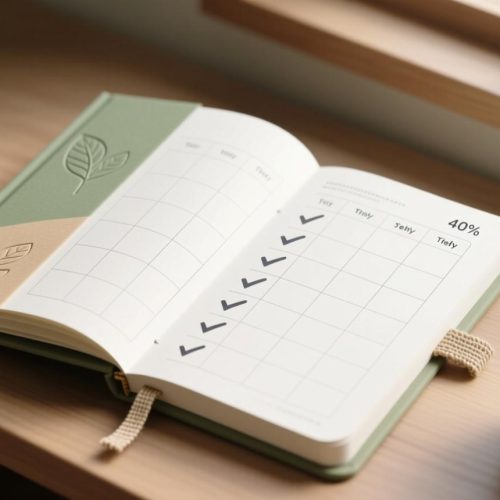
We make a plan on Monday, feel motivated on Tuesday, miss Wednesday, and somehow decide we’ve failed by Thursday. But what if building a habit was never supposed to be that quick?
There is something almost predictable about the way we try to change our lives.
A new month begins, and suddenly we’re convinced this is going to be the month.
We’ll wake up earlier. Exercise regularly. Drink more water. Read before bed. Stop scrolling so much. Perhaps even learn something new.
We download an app, buy a notebook, make a schedule and promise ourselves that this time we’ll be consistent.
For the first few days, everything feels wonderful. We enjoy the little checkmarks, the satisfaction of completing our routines and the feeling that we’re finally becoming the person we’ve been planning to become.
Then life happens.
One morning, we wake up late. One evening, we’re too tired to exercise. A busy week interrupts our reading routine.
And before we know it, we’ve stopped.
Not necessarily because we don’t care anymore, but because we’ve started thinking that missing a few days means we’ve failed.
I find this particularly interesting because we spend so much time discussing the importance of habits, yet very little time discussing how uncomfortable it can be to build them.
So, how long does it actually take to build a habit?
Is it 21 days? 30 days? 90 days?
The research suggests a rather different answer.
1. First, what actually makes something a habit?
Let’s start with a small distinction.
Doing something regularly and having a habit aren’t necessarily the same thing.
For example, imagine that you’ve decided to drink a glass of water every morning.
Initially, you might need a reminder. You might keep a bottle beside your bed or set an alarm on your phone.
You consciously remember the activity, make an effort and complete it.
After repeating it for some time, something changes.
You wake up, get out of bed and reach for the water without having to remind yourself.
That’s the interesting part of habit formation.
A habit gradually becomes more automatic because a familiar situation or cue starts triggering a familiar behaviour.
It isn’t simply about having enough willpower to repeat something every day. It’s about creating a pattern that eventually requires less conscious effort.
And that distinction changes how we should approach building habits.
Instead of constantly asking ourselves to be more disciplined, perhaps we should focus on creating routines that fit naturally into our everyday lives.
2. The famous 21-day rule isn’t a universal scientific deadline
You’ve probably heard that it takes 21 days to form a habit.
It’s one of those statements that gets repeated so often that we’ve almost accepted it as a scientific fact.
But habit formation is considerably more complicated.
A 2024 systematic review and meta-analysis published in Healthcare examined 20 studies involving 2,601 participants and investigated how long it takes to develop health-related habits.
The findings were quite interesting:
- Reported median times to habit formation ranged from approximately 59 to 66 days.
- Reported mean times in the studies that measured them ranged from 106 to 154 days.
- Individual variation was substantial, with reported durations ranging from 4 to 335 days.
The researchers also noted that 11 of the 20 included studies had a high risk of bias, so these figures shouldn’t be treated as universal deadlines. PubMed+1
Think about that for a moment.
Two people could start the same habit on the same day and experience completely different journeys.
One might find it becoming automatic relatively quickly. Another might need several months.
It depends on the behaviour, the person, the environment and how consistently the habit is practised.
So, if you’ve been trying to establish a morning exercise routine for three weeks and still need to convince yourself to get out of bed, it doesn’t mean you’re doing something wrong.
You might simply need more time.
3. Repetition matters, but the situation in which you repeat something matters too
One particularly interesting study by Phillippa Lally and colleagues, published in the European Journal of Social Psychology, explored how habits develop in everyday life.
The researchers asked 96 volunteers to choose an eating, drinking or physical activity behaviour and repeat it daily in a consistent context for 12 weeks.
For example, someone might choose to perform a particular activity after breakfast.
The researchers observed that automaticity gradually increased with repetition.
Among the participants whose habit development could be modelled reliably, the time to reach a high level of automaticity varied considerably, from 18 to 254 days.
Another interesting finding?
Missing one opportunity to perform the behaviour did not materially affect the habit formation process. onlinelibrary.wiley.com+1
This is important because it challenges the way we sometimes think about consistency.
We assume consistency means never missing a day.
But perhaps consistency is better understood as returning to something often enough for it to become familiar.
Consider these two approaches:
Approach A
“I will exercise for 45 minutes every morning at 6 AM.”
Approach B
“After I finish my morning tea, I’ll spend 10 minutes moving my body.”
The first approach might work beautifully for someone with a predictable schedule.
But for someone whose mornings are unpredictable, the second might be easier to maintain.
The goal isn’t to create the most impressive routine.
It’s to create one that has a realistic chance of surviving an ordinary Tuesday.
4. Start with a version of the habit that feels almost too easy
One reason we struggle with new habits is that we often begin with an unrealistic version of what we want to achieve.
We don’t decide to read a little. We decide to read 30 pages every night.
We don’t decide to become more active. We create an entire workout schedule.
We don’t decide to learn something new. We plan an hour of studying every single day.
The enthusiasm is genuine, but the expectations can become exhausting.
A more practical approach is to begin with a smaller version of the behaviour.
For example:
| Big goal | Smaller starting habit |
|---|---|
| Exercise every day | Walk for 10 minutes |
| Read more books | Read 2 pages before bed |
| Drink more water | Drink a glass after waking up |
| Learn a language | Practise for 5 minutes |
| Journal regularly | Write 3 sentences |
| Reduce screen time | Keep your phone away for the first 15 minutes of the morning |
The smaller version isn’t the final destination.
It’s simply a way of making the starting point less intimidating.
Once the behaviour becomes familiar, you can gradually increase it.
And if you have a particularly busy day, you can still maintain a connection with the routine without demanding too much from yourself.
5. Choose a habit that actually fits your life
This is something we often overlook.
We see someone else’s routine and assume that because it works for them, it should work for us too.
Someone wakes up at 5 AM, exercises, meditates, journals and reads before starting work.
It looks wonderful.
So we decide to do exactly the same thing.
But we rarely consider whether their lifestyle, responsibilities, energy levels or preferences resemble ours.
A 2024 systematic review published in the Journal of Medical Internet Research examined 41 studies involving digital behaviour-change interventions for physical activity.
It identified commonly used techniques such as self-monitoring, goal-setting, prompts and cues, as well as positive reinforcement.
The review highlighted the importance of using structured techniques to support the development of repeated behaviours. DOI+1
Another useful finding from the 2024 habit-formation meta-analysis was that factors such as personal choice, enjoyment, timing and the type of behaviour were associated with habit strength. PubMed
This makes sense when you think about it.
If you genuinely enjoy walking, you’re more likely to find a way to include it in your day.
If you dislike running, forcing yourself to run every morning might create a routine that you constantly want to escape.
The point isn’t to avoid doing difficult things.
It’s to distinguish between something that challenges you and something that simply doesn’t suit your life.
You don’t have to copy somebody else’s routine to make progress.
6. Make your environment do some of the reminding
We tend to give motivation a lot of credit.
But motivation is unpredictable.
Some days we wake up feeling enthusiastic. Other days, even the simplest task seems like too much work.
This is where your environment can help.
Instead of relying entirely on remembering to do something, make the behaviour easier to begin.
Here are a few simple examples:
- Want to read more? Keep a book on your bedside table rather than inside a cupboard.
- Want to exercise in the morning? Keep your workout clothes ready the previous night.
- Want to drink more water? Keep a bottle somewhere you can easily see it.
- Want to spend less time scrolling? Move social media apps away from your home screen.
- Want to journal? Leave your notebook and pen somewhere accessible.
You can also connect a new habit to an existing routine.
For example:
- After brushing my teeth, I’ll do five minutes of stretching.
- After making my morning chai, I’ll read two pages.
- After lunch, I’ll take a short walk.
- Before going to bed, I’ll write down one thing I want to remember about the day.
This creates a predictable cue for the behaviour.
The less effort it takes to remember and begin, the easier it becomes to repeat.
7. Stop treating one missed day like a personal failure
I think this deserves its own section because it is where many otherwise good routines fall apart.
We miss one day and feel disappointed.
Then we miss another because we assume we’ve already broken the streak.
Eventually, we stop trying altogether.
It’s interesting how quickly one small interruption can change our perception of progress.
But the research on habit formation doesn’t support the idea that one missed opportunity automatically sends you back to the beginning.
As the Lally study demonstrated, a single missed opportunity did not materially affect the habit formation process. Wiley Online Library
Of course, repeatedly abandoning a routine can make it harder to establish.
But there is a difference between occasionally missing something and deciding that you’re no longer capable of doing it.
Perhaps the more useful question isn’t:
“Why couldn’t I stay consistent?”
It’s:
“What would help me return to this routine tomorrow?”
That small change in perspective can make the process feel considerably less discouraging.
You don’t need to punish yourself for missing yesterday.
You simply need to decide what you’re going to do next.
8. Your habits should change when your life changes
There is another thing about habits that we don’t always acknowledge.
The routines that work beautifully during one phase of life might not work during another.
Perhaps you had plenty of time to exercise when you were studying.
Now you have a full-time job and family responsibilities.
Perhaps you used to read every evening, but your schedule has become unpredictable.
Maybe your morning routine worked perfectly until you moved houses or changed jobs.
That doesn’t mean you’ve lost your discipline.
It might simply mean your routine needs updating.
A habit isn’t supposed to become another responsibility that makes you feel guilty.
It should support the life you’re actually living.
Sometimes that means reducing the duration, changing the timing or choosing a completely different way to achieve the same goal.
And that’s perfectly reasonable.
9. So, how do you build habits that actually last?
If I had to simplify everything we’ve discussed into a practical approach, it would look something like this:
Step 1: Pick one habit.
Don’t attempt to redesign your entire life in one week.
Step 2: Make it specific.
Instead of saying, “I want to become healthier,” decide exactly what you want to do.
Step 3: Connect it to an existing routine.
Choose a familiar moment that can act as a reminder.
Step 4: Start small.
Make the first version of the habit manageable enough to repeat.
Step 5: Make it enjoyable and accessible.
Reduce unnecessary friction and choose an approach that suits your preferences.
Step 6: Track your repetitions without obsessing over perfection.
A simple calendar or notebook can help you notice progress.
Step 7: Return after interruptions.
Don’t let one missed day become a reason to abandon the entire plan.
You don’t need a complicated productivity system.
You need a routine that makes sense for your life.
Perhaps the real goal isn’t to become a more disciplined person
I think we’ve become a little too obsessed with the idea of transforming ourselves.
Every new month comes with a new list of things we want to fix.
We want to wake up earlier, eat better, exercise more, read more, work harder and become more organised.
And sometimes, in the middle of all this planning, we forget that we’re allowed to be imperfect while we’re figuring things out.
Building a habit isn’t a competition.
You don’t get a special reward for completing a 30-day streak, and you haven’t failed at personal growth because you needed 100 days instead.
Perhaps the most important part of building a habit is learning how to return to it.
After a busy week. After a holiday. After an unexpected interruption. After one of those days when absolutely nothing goes according to plan.
Because eventually, the goal is for the behaviour to become part of your life rather than another task you’re constantly trying to complete.
And perhaps that’s a much better definition of consistency.
Not doing everything perfectly.
Just finding your way back, often enough, until it starts feeling like something you naturally do.
You don’t have to change your entire life by next Monday. You can start with one small thing today.
With love,
Little Blue Moon 🌙