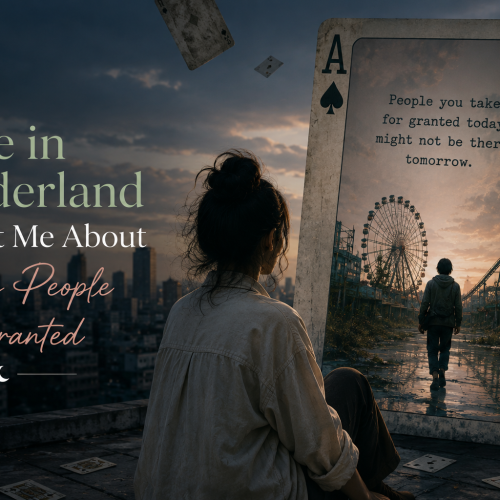
There’s a moment early in Alice in Borderland where one of the players, suddenly dropped into a world with no responsibilities, no one to answer to, and no one to disappoint, feels something close to relief. No work. No arguments. No one demanding anything of him. For a few minutes, that emptiness looks almost like freedom.
I understood that feeling more than I wanted to admit. There’s a fantasy tucked inside all of us about what life might feel like with the noise turned off — no obligations, no one needing anything from us. It sounds peaceful, right up until it isn’t. It’s easy to slip into taking people for granted when nothing’s forcing you to notice.
The Moment Everything Flips
It doesn’t take long for that relief to curdle. As soon as the games turn deadly — as soon as death becomes a real, immediate possibility — the same players who felt unburdened by their empty world are suddenly consumed by the people they left behind. Not their jobs. Not their routines. The people. Faces they hadn’t thought about in the “freedom” of being alone suddenly become the only thing that matters.
It’s such a specific, human contradiction — we complain about the weight our relationships put on us, and then the second we’re faced with losing everything, those same relationships are all we can think about
Why That Hit Closer Than I Expected
Watching that shift happen on screen made me uncomfortable in a very familiar way. I thought about how often I let the small friction of daily life with the people I love overshadow how much they actually mean to me. The short replies when I’m tired. The eye roll at a question I’ve answered a hundred times. The way I sometimes treat the people who are always there as if they’ll always just be there, no urgency required.
Watching that shift happen on screen made me uncomfortable in a very familiar way. I thought about how often I let the small friction of daily life with the people I love overshadow how much they actually mean to me. The short replies when I’m tired. The eye roll at a question I’ve answered a hundred times. The way I sometimes treat the people who are always there as if they’ll always just be there, no urgency required.
There was a day recently when I caught myself thinking about someone I love who wasn’t around. Nothing had happened. There was no fight, no dramatic reason, no particular conversation I was waiting for. He was simply away. And yet, the house felt strangely different. I realised I wasn’t even missing a conversation. I was missing his presence — the random messages, the possibility of looking up and finding him there, even the comfortable silence of just sitting together without saying anything.
It made me wonder how easily we get used to the people who become part of our everyday lives. We stop noticing the little things because they become so familiar. We know they’ll message. They’ll come home. They’ll sit beside us. They’ll answer when we call. And because that becomes our normal, we forget that there is actually something incredibly precious about being able to expect someone’s presence. Maybe taking people for granted doesn’t always look like not caring. Sometimes, it simply looks like forgetting to notice how much someone’s existence has quietly become a part of yours.
We don’t need a deadly game to teach us this lesson, but somehow it often takes something dramatic — a scare, a loss, a near-miss — before we remember what was in front of us the whole time.
We don’t need a deadly game to teach us this lesson, but somehow it often takes something dramatic — a scare, a loss, a near-miss — before we remember what was in front of us the whole time. The show just compressed that realization into a matter of minutes instead of letting it creep up on us over years, the way it usually does in real life
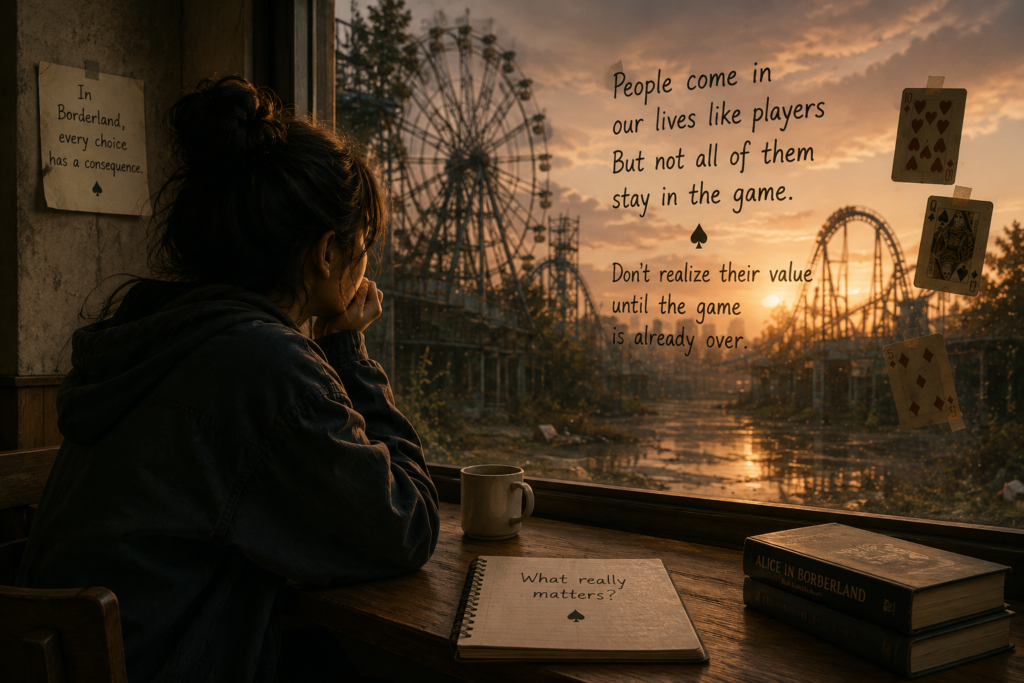
Carrying It Off the Screen
I don’t think the answer is to live in constant fear of losing people — that’s its own kind of exhausting. But I’ve been trying to sit with a smaller version of that urgency lately. Actually looking up when someone’s talking to me. Not saving the “I love you” for big moments only. Letting the small daily version of care matter as much as the big gestures do.
It’s strange what a show about survival games taught me about presence. Somewhere between the tension of watching characters run for their lives, I ended up thinking less about the game itself and more about who I’d want to call if I only had a few hours left — and how easily I forget to treat today like it might be one of those hours — how quickly presence turns into taking someone for granted when nothing’s making you look up.